Items
Tag
African American Women
-
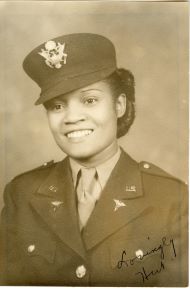
Madeleine Berthelot, 1946 Series of photographs of Madeleine Berthelot taken during a visit to the French Riviera in May 1946. The images show Berthelot posing in front of prominent locations including the Hotel Ruhl in Nice, the Promenade des Anglais, and the Hotel Martinez in Cannes. Her tailored coat, handbag, and composed stance reflect postwar fashion and the culture of travel along the Mediterranean coast in the immediate aftermath of World War II. -
Lucille V. Hill (nee King), Tuskegee Institute, 1945 Yearbook portrait of Lucille V. Hill (née King), identified as “Cille,” a nursing education student at Tuskegee Institute, 1945. The accompanying yearbook text notes her hometown of Thomaston, Georgia, and lists several campus activities and organizations, reflecting the active student life and professional training available to Black women at Tuskegee during the 1940s. -
Gloria L. Smith (left) Miss Black America and Reda Wyatt (right) Miss Atlanta NAACP at Paschal Brothers Motel Photograph of Gloria L. Smith (left), Miss Black America, and Reda Wyatt (right), Miss Atlanta NAACP, standing outside the Paschal Brothers Motel in Atlanta, Georgia, October 19, 1969. Both women are dressed in late-1960s fashion, with Wyatt gesturing in the distance. The Paschal Brothers Motel was an important gathering place for African American civic leaders during the Civil Rights era. Photograph by Harmon Perry. -
Four 1940 Spelman Graduates Head Procession from Sisters Chapel Photograph showing four graduating students from Spelman College leading a commencement procession from Sisters Chapel, circa 1940. The students walk together carrying a banner bearing the college emblem while other participants stand along the pathway observing the ceremony. The procession moves beneath a wooden arch on the college grounds, framed by trees and landscaped lawns. The students wear light-colored dresses typical of formal collegiate ceremonies of the period. Processions such as this were a traditional part of commencement exercises at Spelman College, marking the formal transition of students from academic study to professional and civic life. Founded in 1881, Spelman College has long been one of the nation’s leading historically Black colleges for women, educating generations of African American leaders in education, public service, and the arts. -
Florie Trice and Martha Greer Bentley Photograph of Florie Trice and Martha Greer Bentley during an event associated with the National Conclave of Grady Graduate Nurses, taken in 1965. The image shows Martha Greer Bentley standing and signing a document on a table while Florie Trice sits nearby observing the moment. A man stands behind the table, leaning forward to watch the signing. Floral arrangements and formal attire suggest the occasion was part of a ceremonial or organizational gathering. The photograph documents the professional and social activities of African American nurses connected with the Grady Graduate Nurses organization. Professional nursing associations such as this played an important role in supporting Black medical professionals during the twentieth century, providing networks for professional advancement, leadership development, and community service during a period when opportunities in many medical institutions remained limited by racial discrimination. -
Carolyn Fouch Walker (granddaughter of Ruby Blackburn) holding paper with Gov. Herman Talmadge at YMCA, undated Photograph of Carolyn Fouch Walker, granddaughter of Ruby Blackburn, standing with Herman Talmadge at a YMCA (Young Men's Christian Association) event, circa the early 1960s. Walker holds a document while speaking with Talmadge, who served as governor of Georgia from 1948 to 1955 and later as a United States senator. The scene appears to take place inside a YMCA facility, indicated by the banner visible in the background reading “Young Men’s Christian Association.” A microphone stand and trophy placed nearby suggest the occasion may have been part of a ceremony, youth program, or recognition event. Walker is dressed in formal attire and appears to be receiving or presenting a document during the event. The photograph documents a moment of civic engagement and community programming involving local organizations and public officials during the early 1960s. -
Francis Fouch (Ruby Blackburn's daughter) and group at tea, undated Photograph of Francis Fouch, daughter of Ruby Blackburn, standing with a group of women at a social tea gathering, circa the late 1940s. The women are dressed in formal attire typical of the period, including dark dresses, jewelry, and styled hair, reflecting the elegance and social customs of mid-twentieth-century African American community gatherings. The group stands indoors behind a table set with a teapot, serving pieces, and pastries, suggesting a formal tea or social reception. Francis Fouch appears among the group alongside Hattie Holmes and other attendees. Such gatherings were important social spaces within African American communities, providing opportunities for fellowship, networking, and civic engagement. -
Big Bethel A.M.E. Church Concert Choir, 1947 Photograph of the concert choir of Big Bethel A.M.E. Church in Atlanta, Georgia, taken on July 21, 1947. The group is assembled inside the church sanctuary, posed in several rows in front of the large pipe organ. Members of the choir wear coordinated attire—white blouses paired with long dark skirts—reflecting the formal presentation typical of church concert choirs during the mid-twentieth century. The choir was directed by H. J. Furlow, who served as the ensemble’s musical leader at the time. Big Bethel A.M.E. Church, one of Atlanta’s oldest and most historically significant African American congregations, has long been known for its strong musical tradition and community programming. Concert choirs such as this played a central role in worship services, musical programs, and special events, helping to cultivate sacred music traditions and communal fellowship within the church. -
Big Bethel A.M.E. Church Choir, undated Group photograph of the choir of Big Bethel A.M.E. Church in Atlanta, Georgia, taken between approximately 1946 and 1953. The image shows a choir of men and women standing in several rows on a stage while a conductor leads them in song. The singers wear coordinated dark attire with light collars, typical of mid-twentieth-century church choir uniforms. The conductor stands at the left foreground with his arm raised, directing the performance. A microphone positioned near the front suggests the performance may have been part of a recorded broadcast, public program, or special church event. Big Bethel A.M.E. Church, founded in 1847, has long served as one of Atlanta’s most prominent African American congregations and a center of religious, cultural, and civic life in the city. Church choirs such as this played an important role in African American communities during the mid-twentieth century, contributing to worship services while also fostering musical training, fellowship, and community identity. -
Nannie Burroughs presents flowers to MacBeth star Edna Thomas Photograph showing educator and activist Nannie Helen Burroughs presenting a large floral arrangement to stage and film actress Edna Thomas following a performance of MacBeth, circa 1936. Thomas, an Atlanta-born performer known for her work in theater and early American film, stands near the center of the image receiving the bouquet. Other individuals identified in the photograph (from left to right) include Mrs. U. R. McDodana, Jesse O. Thomas, Samuel Houston, and John Silvera, who appears in the background. The group is gathered indoors, dressed in formal attire typical of the mid-1930s. The image documents a moment of recognition celebrating the achievements of an African American performer during a period when Black artists and intellectuals were expanding their presence in American theater, film, and cultural life despite the limitations imposed by segregation. The photograph forms part of the Jesse O. Thomas papers. -
Elsie A. Cuff, 1936 Portrait photograph of Elsie A. Cuff taken in 1936 while she was a student at Virginia State College (now Virginia State University). The image shows Cuff posed against a studio backdrop, wearing a dark blouse with a rounded collar. Her hairstyle and clothing reflect the fashion of the mid-1930s. Studio portraits such as this were commonly produced for school records, yearbooks, or personal keepsakes during the early twentieth century. The photograph preserves the likeness of a young African American college student during a period when historically Black colleges and universities played a vital role in expanding educational opportunities and professional pathways for Black Americans. The photograph is part of the Jesse O. Thomas papers. -
Unidentified woman in fur coat, undated Sepia-toned photograph of an unidentified woman standing outdoors near a wooden structure, likely a porch or small building. She is dressed in a long coat with a fur collar and holds what appears to be a fur muff, accessories commonly associated with winter fashion during the late 1920s and early 1930s. Her clothing and posture suggest a posed snapshot taken during colder weather. The photograph reflects everyday life and personal style during the early twentieth century. Images such as this often appeared in family albums or scrapbooks, preserving informal moments and individual portraits outside the studio setting. -
Spelman students gathering in the old barn, Spelman College, (photo reprinted The Messenger, November 1937) Magazine spread featuring a photograph of students gathered in the Old Barn on the campus of Spelman College during a commemorative service held on October 18, 1937. The image shows a large assembly of students seated closely together while speakers stand on a staircase addressing the crowd. The event reflects the traditions of campus gatherings and commemorations that brought together students, faculty, and visiting leaders. Individuals identified in the caption include Dr. Otis W. Caldwell of Atlanta University, Dr. Rufus E. Clement, President of Atlanta University, Mrs. Johnnie Louise Fowler representing Spelman alumnae, Dean Jane Hope Lyons, and Spelman College President Florence M. Read. Also noted are Mr. Trevor Arnett, President of the Board of Trustees, and student representatives including Miss Eloise Usher and Mrs. Claudia White Harreld. The photograph was originally taken in 1936 and later reproduced in the November 1937 issue of The Spelman Messenger. -
Antique Photographs: Alice, undated Sepia-toned studio portrait of a young woman identified as Alice, dating to approximately 1927–1930. She stands facing the camera against a plain studio backdrop, wearing a light-colored dress with a white apron and cap. Her clothing suggests either domestic service attire or a work uniform commonly worn by women employed in household or hospitality roles during the early twentieth century. The portrait reflects the conventions of studio photography of the period, in which individuals posed formally to create keepsake images for family members and personal collections. Images such as this document the lives and labor of African American women during the early twentieth century, preserving individual identity and presence within family and community histories. The photograph is part of the William and Mary Jackson Collection. -
Unidentified group sitting at table, undated Black-and-white photograph showing a group of men and women seated together at a long dining table during a social gathering, dating to approximately 1919–1922. The individuals are dressed in formal attire typical of the early twentieth century, suggesting a special occasion such as a banquet, club meeting, or celebratory event. The table is decorated with a tall centerpiece, and the room is adorned with streamers and other festive decorations. The image captures a moment of community life and social fellowship, reflecting the importance of gatherings, clubs, and communal meals within African American communities during the early twentieth century. The photograph is part of the Mabel Vernon Alford Collection and is preserved at the Auburn Avenue Research Library on African American Culture and History, part of the Fulton County Library System. -
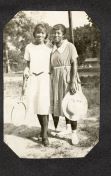
Unidentified group of women smelling flowers, undated Sepia-toned photograph of a group of young women gathered around a flowering bush, smiling and smelling the blossoms. The women lean over the flowers and appear relaxed and playful, suggesting a candid moment captured outdoors beside a brick building. Their hairstyles and clothing—loose dresses, jackets, and waved or bobbed hair—reflect early twentieth-century fashion. The image offers a glimpse of leisure and friendship among young African American women during the late 1910s or early 1920s. Informal photographs like this often documented everyday moments shared among friends and family, preserving scenes of social life, beauty, and joy within community settings. The photograph is part of the Mabel Vernon Alford Collection. -
Unidentified woman next to car, undated Photograph of an unidentified woman standing beside an automobile on a city street, dating to approximately 1928–1932. The woman wears a cloche-style hat and a tailored coat typical of late 1920s and early 1930s fashion. Two children stand nearby, one leaning against the automobile while another stands slightly behind her. In the background, multi-story buildings, fire escapes, and other automobiles line the street, situating the scene within an urban neighborhood. Images such as this offer glimpses of everyday life during the early twentieth century, documenting fashion, family relationships, and the growing presence of automobiles in city environments. The photograph comes from the Williams family scrapbook and reflects the kinds of informal snapshots families preserved to record daily experiences and community life. -
Unidentified Woman at The Regent, undated Studio portrait of an unidentified woman seated beside a decorative chair, photographed at The Regent studio operated by J.E. Purdy & Co.. The woman wears an elaborately patterned dress with a fitted bodice, lace collar, and ornamental hat typical of late nineteenth-century fashion. Her formal pose, jewelry, and carefully styled attire reflect the conventions of studio portraiture during the 1890s, when photographic portraits served as important personal and family keepsakes. The cabinet card photograph comes from the Selena Sloan Butler papers. While the woman’s identity has not been confirmed, she may be a relative of Selena Sloan Butler, though this attribution remains unverified. -
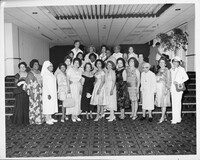
Links, Inc. - National Organization, Links members Color photograph showing members of The Links, Incorporated gathered at a national organizational event during the 1983–1984 program year. Six women stand together indoors, smiling and posing for the camera while wearing formal attire accented with corsages or floral boutonnieres, suggesting a ceremonial or celebratory occasion associated with the organization. Founded in 1946, The Links, Incorporated is a prominent service organization of professional African American women dedicated to friendship, civic engagement, and community leadership. Photographs such as this document the fellowship and national network of members who participated in conferences, service initiatives, and social gatherings across chapters during the late twentieth century. -
Ruth Chapter O.E.S. [Order of the Eastern Star], 1978 Group photograph of members of the Ruth Chapter of the Order of the Eastern Star taken in 1978. The image shows a large gathering of chapter members and officers assembled inside a meeting hall, many wearing ceremonial white attire and sashes associated with the fraternal organization’s rituals and leadership roles. Several men are also present, likely members affiliated with the Masonic order connected to the chapter. Framed certificates, flags, and a star emblem appear in the background, reinforcing the chapter’s fraternal and ceremonial setting. The photograph documents the social, spiritual, and community-building role that organizations like the Order of the Eastern Star played within African American communities during the twentieth century, providing fellowship, leadership opportunities, and charitable service. -
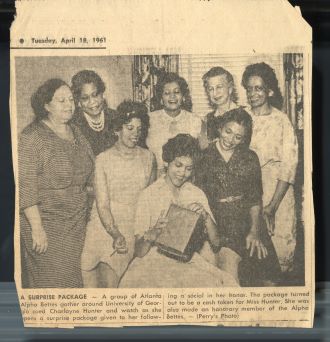
Newspaper Clipping, Alpha-Bettes honor Charlayne A. Hunter, 1961 Newspaper clipping published April 18, 1961 in the Atlanta Daily World showing Charlayne A. Hunter surrounded by members of the Alpha-Bettes, a civic and social organization of Atlanta women. The gathering was held in her honor shortly after her historic enrollment at the University of Georgia. The photograph captures Hunter opening a surprise gift presented during the event while members of the Alpha-Bettes look on. According to the caption, the package contained a cash token and Hunter was also made an honorary member of the group. The moment reflects the strong network of support from Atlanta’s Black women’s organizations for Hunter during the early stages of school integration in the American South. -
Undergrads pose with Founders, The Archon, Zeta Phi Beta Sorority Magazine page from The Archon featuring the article “Accent on Undergraduates,” published in December 1966. The page highlights the participation and achievements of undergraduate members of Zeta Phi Beta Sorority, Inc., emphasizing the organization’s commitment to leadership development, scholarship, and sisterhood among college students. The lower photograph shows undergraduate members posing with sorority leaders, including founders and national officers, during the Atlantic Regional Conference held October 14–16, 1966. The caption notes the presence of Grand Basileus Bradham and other leaders, with the Epsilon Omega Zeta Chapter serving as host. The page reflects the intergenerational mentorship and leadership structure that connects undergraduate members with the sorority’s national leadership. -
From 1961-62 Scrapbook, Group Photo w/ Coretta Scott King, Atlanta Links Scrapbook page from the 1961–1962 records of the The Links, Incorporated, Atlanta Chapter, featuring a group photograph of chapter members gathered for a chapter event. The page notes the installation of Marge Yancey and the transfer of Coretta Scott King from the Birmingham chapter to the Atlanta chapter. The photograph shows members seated and standing together in a living room setting, reflecting the social and civic fellowship that characterized the organization’s gatherings. The inclusion of Coretta Scott King highlights the close connections between professional women’s organizations like The Links and the broader civil rights leadership community in Atlanta during the early 1960s. -
Links in Nassau, Bahamas, Atlanta Daily World Newspaper clipping from the Atlanta Daily World reporting on members of The Links, Incorporated attending a reception in Nassau, Bahamas, during the organization’s 14th National Assembly in 1964. The article includes photographs of visiting members and describes a reception held at the home of Sir Stafford Sands, who welcomed members of the organization. Among those mentioned is Atlanta Links member Mrs. L. E. Frazier, who attended the assembly and reception. The event highlights the international reach and influence of The Links during the mid-twentieth century, as members engaged in cultural exchange, civic leadership, and social events beyond the United States. -
Two Atlanta Links Members at Benjiman E. Mays Banquet Photograph of two members of The Links, Incorporated, Atlanta Chapter, speaking together at a podium during the Benjamin E. Mays Banquet in the 1950s. The women stand close to a microphone, appearing to exchange remarks or present an award. Floral arrangements and banquet tables are visible in the foreground, while other attendees sit nearby. The event honored Benjamin E. Mays, a prominent leader in African American education and civil rights. The image reflects the role of The Links in supporting educational initiatives, civic engagement, and community leadership within Atlanta’s Black professional community during the mid-twentieth century.