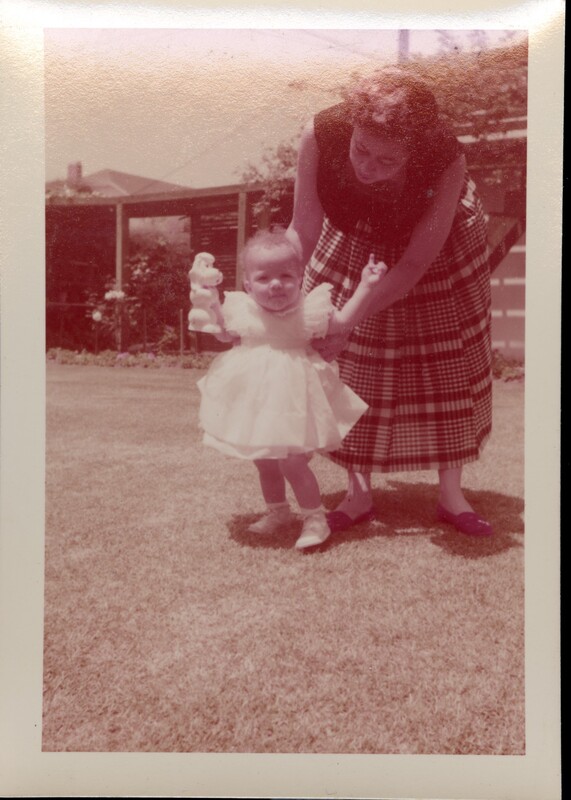
Color photograph of Rheba Butler and her daughter, Darrilyn Selena Butler (granddaughter of Selena Sloan Butler), taken in June 1956. The child, dressed in a light-colored dress, holds a toy poodle while being supported by her mother outdoors on a lawn, capturing a tender family moment.
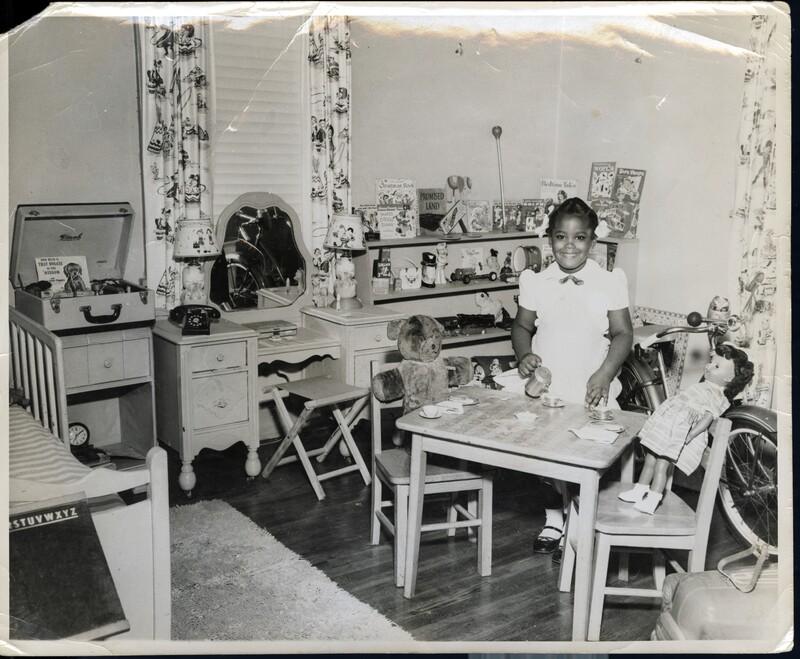
Photograph of an unidentified young girl hosting a tea party with toys, circa 1950s. The girl stands at a small table set with miniature dishes, surrounded by dolls, a teddy bear, and other toys in a neatly arranged bedroom, capturing a moment of imaginative play and childhood.
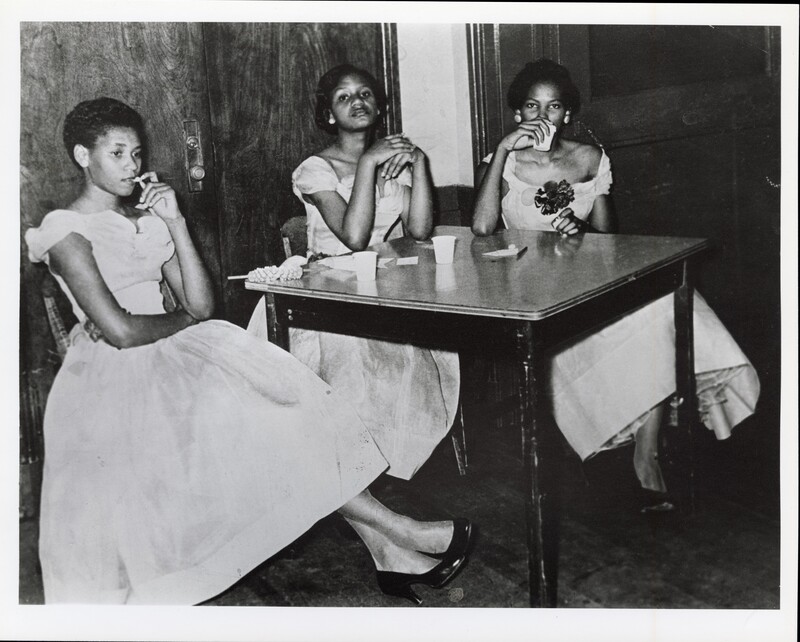
Photograph of three young women seated at a table in party dresses, circa 1950s. The women wear formal evening attire and appear relaxed, holding drinks and socializing, capturing a moment of leisure and youthful elegance.
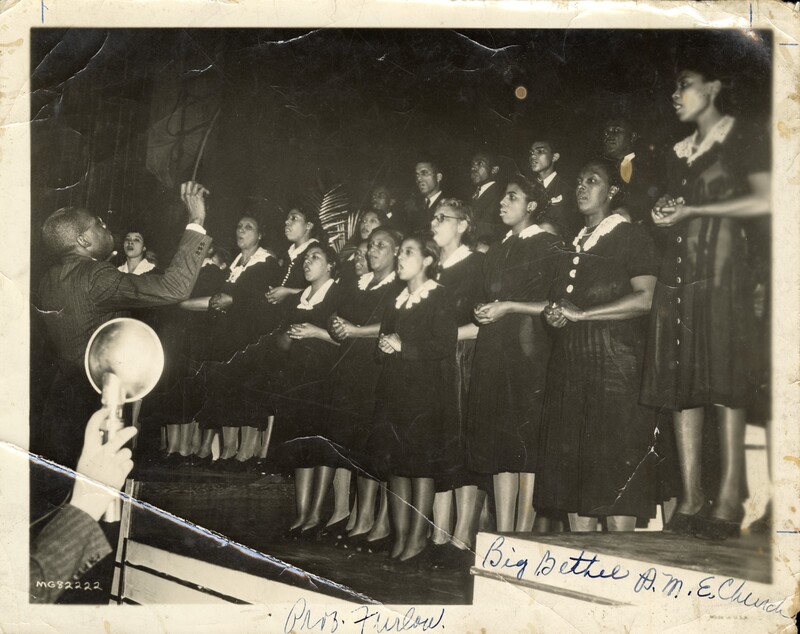
Group photograph of the choir of Big Bethel A.M.E. Church in Atlanta, Georgia, taken between approximately 1946 and 1953. The image shows a choir of men and women standing in several rows on a stage while a conductor leads them in song. The singers wear coordinated dark attire with light collars, typical of mid-twentieth-century church choir uniforms.
The conductor stands at the left foreground with his arm raised, directing the performance. A microphone positioned near the front suggests the performance may have been part of a recorded broadcast, public program, or special church event. Big Bethel A.M.E. Church, founded in 1847, has long served as one of Atlanta’s most prominent African American congregations and a center of religious, cultural, and civic life in the city.
Church choirs such as this played an important role in African American communities during the mid-twentieth century, contributing to worship services while also fostering musical training, fellowship, and community identity.
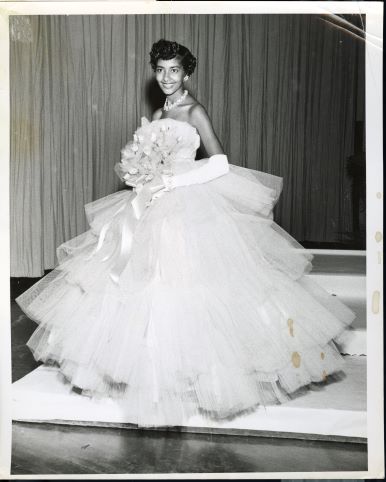
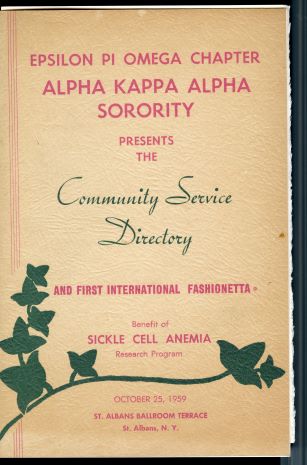
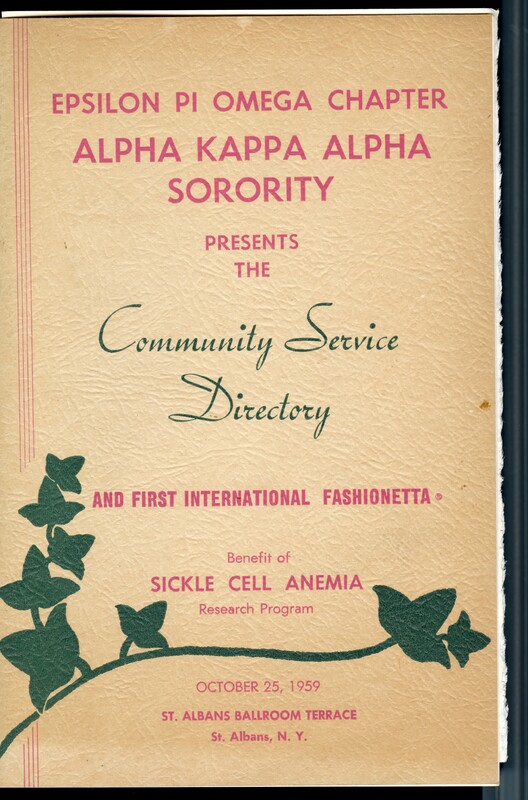
Program booklet produced by the Alpha Kappa Alpha Sorority, Inc., Epsilon Pi Omega Chapter, for a community event held on October 25, 1959, at the St. Albans Ballroom Terrace in St. Albans, New York. The booklet accompanied the chapter’s Community Service Directory and the First International Fashionetta, a fundraising fashion show organized to benefit sickle cell anemia research.
Fashionetta programs were widely used by Alpha Kappa Alpha chapters as community-based fundraising initiatives that combined fashion, scholarship support, and public service. The event documented in this program reflects the sorority’s commitment to civic engagement, health advocacy, and community uplift during the mid-twentieth century.
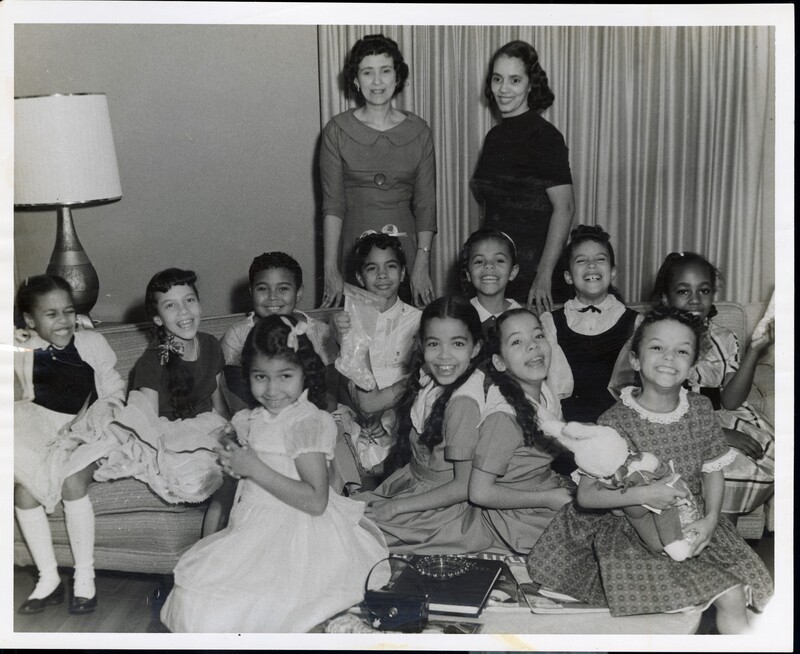
Photograph of a group of young girls gathered indoors with two adult women, taken around the 1950s. In the front row, center, are Caren and Carolyn Yancey, daughters of Asa G. Yancey Sr.. The girls are identified as members of “Jack and Jill of America,” a national organization that supports leadership development, cultural awareness, and social engagement for African American children.
The children sit and stand closely together on a sofa and floor, smiling toward the camera, some holding dolls or toys. Two adult women stand behind them, likely supervising the gathering. The setting appears to be a living room, suggesting a social or educational activity organized through the Jack and Jill chapter. The image captures the importance of community networks that nurtured friendship, cultural pride, and leadership among African American youth during the mid-twentieth century.
Photograph of two members of The Links, Incorporated, Atlanta Chapter, speaking together at a podium during the Benjamin E. Mays Banquet in the 1950s. The women stand close to a microphone, appearing to exchange remarks or present an award. Floral arrangements and banquet tables are visible in the foreground, while other attendees sit nearby.
The event honored Benjamin E. Mays, a prominent leader in African American education and civil rights. The image reflects the role of The Links in supporting educational initiatives, civic engagement, and community leadership within Atlanta’s Black professional community during the mid-twentieth century.
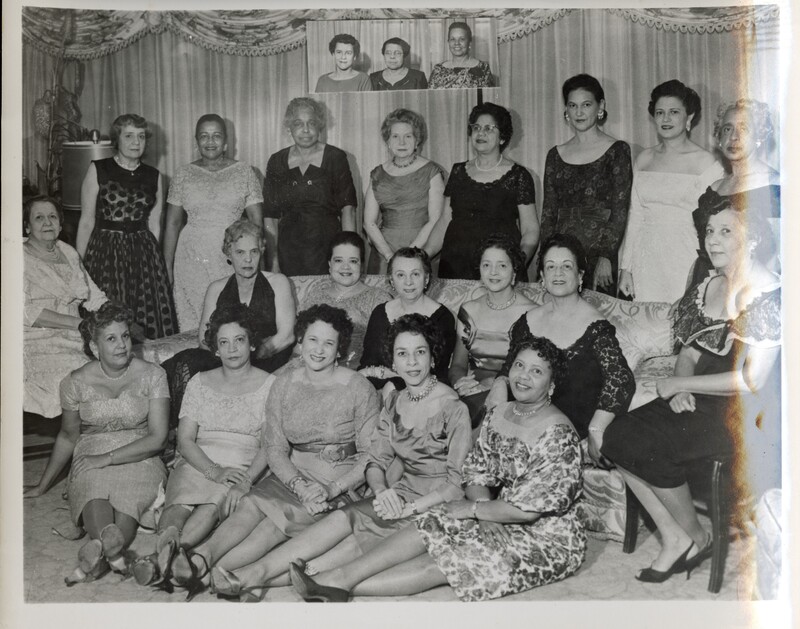
Group portrait of members of the The Links, Incorporated, Atlanta Chapter, photographed during a formal gathering in the 1950s. The women are arranged in several rows in a living room setting, seated on the floor and sofa while others stand behind them. Dressed in elegant evening gowns and cocktail dresses, they present a composed and celebratory image of fellowship and civic leadership.
Founded in 1946, The Links is a national organization of African American professional women dedicated to community service, cultural enrichment, and civic engagement. Photographs like this one document the strong networks of friendship and mutual support that characterized the organization’s early decades, particularly among women leaders in Atlanta’s civic and cultural life.
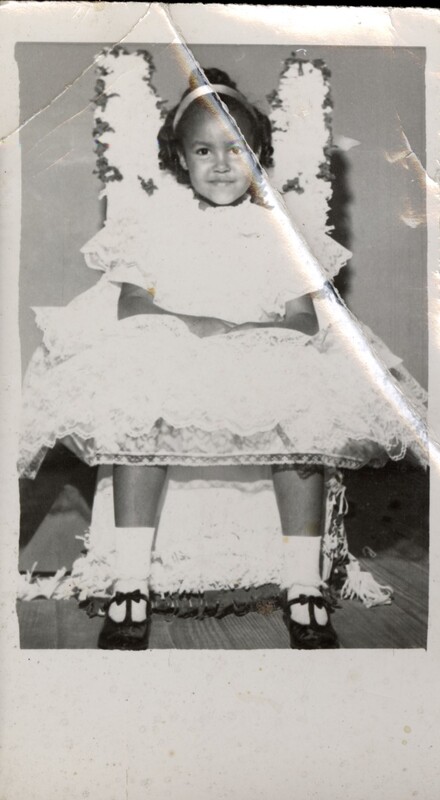
Portrait of a young African American girl seated on a decorated chair, photographed around the 1950s. The child is dressed in a frilly formal dress with lace trim, white socks, and Mary Jane shoes. A headband adorns her hair, and she smiles gently toward the camera. The carefully arranged outfit and decorative chair suggest the photograph was taken for a special occasion or formal portrait. The image reflects the pride families took in presenting their children with care, elegance, and celebration during mid-twentieth-century African American family life.
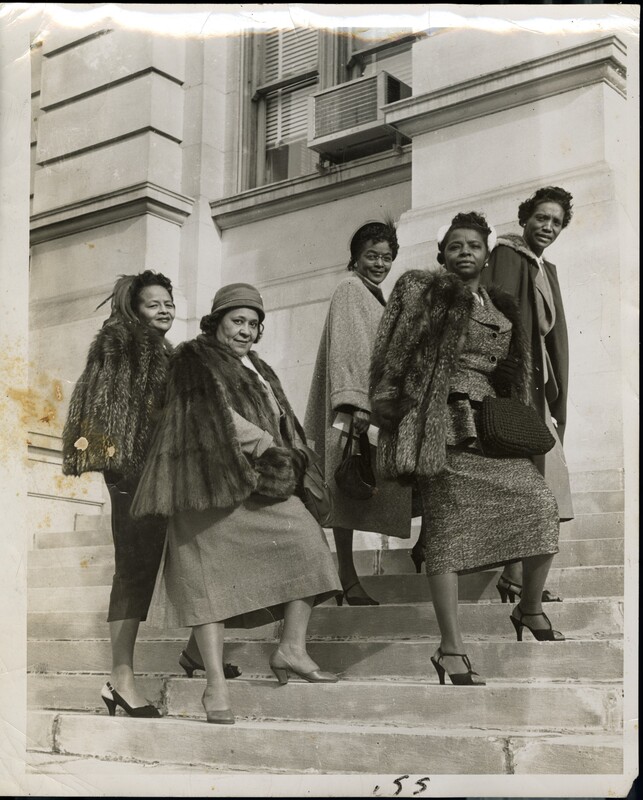
Group portrait of five African American women standing on the steps of a public building, photographed in 1955. From left to right are Mrs. Lula Cornelius, Mrs. Lillie Sanders, Mrs. John Taylor, Mrs. Mamie Render, and Ruby Blackburn. The women are dressed in fashionable coats, fur stoles, and heeled shoes, reflecting the style, dignity, and social presence of Black women in mid-twentieth-century community and civic life.
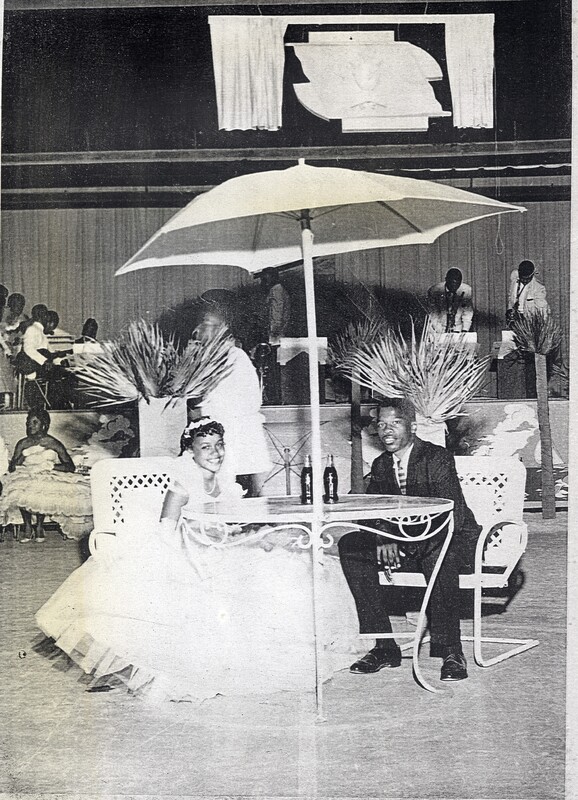
Photograph of Rosemary Braxton seated with her prom date at a decorated high school prom, circa 1950. Braxton wears a formal gown and tiara, seated at a table beneath a large parasol centerpiece while a band performs in the background. The image captures a moment of celebration and elegance among African American youth, reflecting the importance of school dances and social rituals in mid-twentieth-century Black community life.
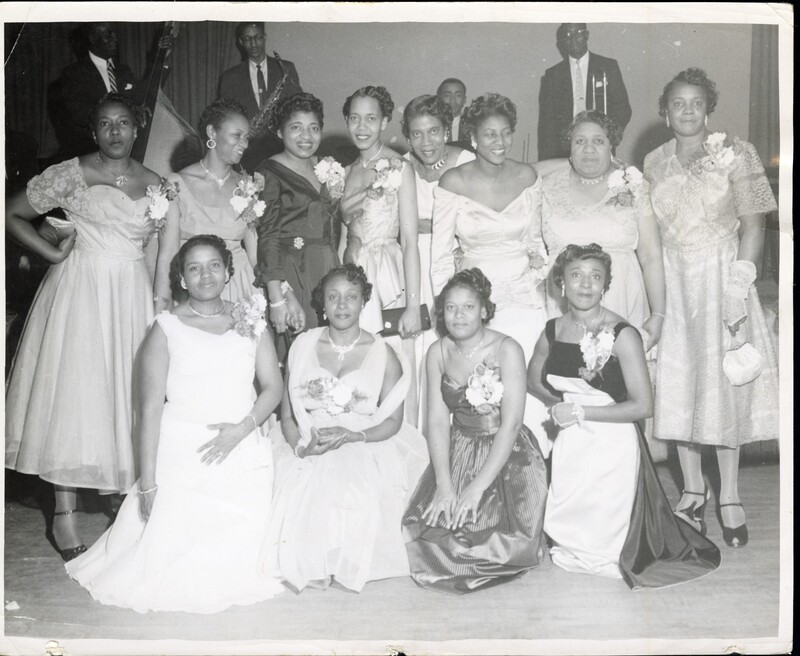
Group portrait of Frances Lawrence and several other African American women dressed in formal evening gowns during a mid-1950s social gathering associated with the National Conclave of Grady Graduate Nurses. The women are posed together on a stage in corsages and elegant attire, reflecting the sophistication and social traditions of professional Black women’s networks in the mid-twentieth century.
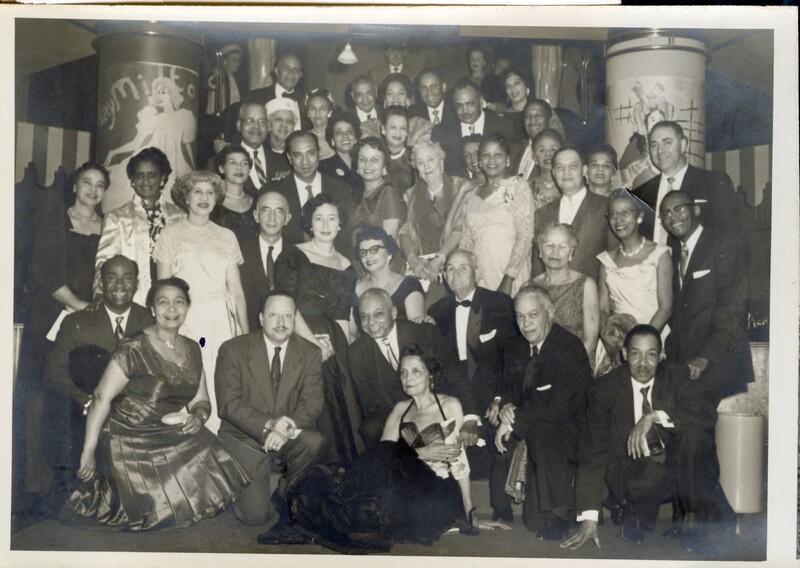
Black-and-white photograph of a group of elegantly dressed African American women and companions gathered at Frank Sennes’ Moulin Rouge nightclub in Hollywood, California, 1957. The women wear formal evening gowns, fur stoles, and styled coiffures typical of mid-century fashion, reflecting the glamour and sophistication of African American social life during the 1950s.